1. Förstå kylningsprocessen

1.1 Grunderna för släckning
Quenching is a heat treatment process where steel is heated to a specific temperature, typically above the critical point (Ac3 or Ac1 for different types of steel), held for a certain period to allow for a phase transformation to austenite, and then rapidly cooled. This rapid cooling is usually done in media such as water, oil, or air. The purpose is to obtain a martensitic structure in the steel, which is known for its high Hårdhet . Men typen av släckning - oavsett om den är singel eller flera - kan ha en djupgående effekt på de slutliga egenskaperna för stålskottet .
1.2 Enkel kylningsprocess
For single quenched steel shot, the manufacturing process generally involves melting high - quality steel blocks or fragments. The molten steel is then formed into small balls, often by high - pressure water jetting or centrifugal force. After that, it is quenched for the first and only time. This single quenching aims to achieve a basic level of hardness in the steel Skott . När det släcktes, torkas skottkroppen och värms sedan upp och härdas i en ugn för att nå den önskade hårdhetsnivån . Det härdade stålskottet sorteras äntligen i olika betyg enligt SAE (Society of Automotive Engineers) Standard genom mekanisk screening för användning i skott eller skottutrustning
1.3 DubbelkylningBearbeta
The process for twice quenched steel shot is more complex. First, the steel shot undergoes a similar initial quenching as in the single - quenched process. After the first quenching, which imparts an initial high hardness and some level of wear resistance, the steel shot is subjected to a second quenching. This second quenching is carefully designed to further optimize the internal structure of the steel Skott . Innan den andra släckningen utförs vanligtvis en härdningsbehandling efter den första släckningen för att lindra inre spänningar . den andra uppvärmnings- och kylningsprocessen förfinar mikrostrukturen, vilket leder till förbättrade mekaniska egenskaper såsom förbättrad seghet och trötthetsresistens.}}}}
2. Prestationsskillnader

2.1 Jämförelse av hårdhet
Single Quenched Steel Shot: The hardness of single quenched steel shot typically reaches a certain level, which is suitable for general - purpose surface treatment tasks. However, compared to twice quenched steel shot, it may not offer the same high - level hardness required for more demanding applications. For example, in applications where rapid and efficient removal of thick rust layers or tough coatings is needed, single quenched steel shot kanske kämpar för att tillhandahålla den nödvändiga skärkraften .
Två gånger släckt stålskott: After two quenching treatments, the hardness of the steel shot can be significantly increased. It often achieves a hardness level of HRC 45 - 50 or even higher in some cases, depending on the alloy composition of the steel. This high hardness makes it extremely effective in applications where high - strength surface cleaning, such as in the aerospace industry for removing stubborn oxide layers from flygplanskomponenter, krävs .
2.2 Tuffhet och trötthetsmotstånd
Single Quenched Steel Shot: The microstructure of single quenched steel shot may have relatively coarser grains. As a result, its toughness and fatigue resistance are not as high as those of twice quenched steel shot. During repeated impact in applications like shot blasting, single quenched steel shot is more likely to break or chip, reducing its service life.
Två gånger släckt stålskott: Den andra släckningsprocessen förfinar kornstrukturen för stålskottet . fina - Korniga strukturer är kända för sin förbättrade seghet och trötthetsresistens . Två gånger släckt stålskott kan motstå mer upprepade effekter utan att bryta, göra det idealiskt för appliceringar som kräver lång tid och kontinuerligt och kontinuerligt användning, såsom i stort sett, där det är mer upprepat. klocka .
2.3 Bärmotstånd
Single Quenched Steel Shot: While it has a certain℃of wear resistance, the wear rate of single quenched steel shot can be relatively high, especially when used in abrasive environments for an extended period. This is because the less - refined microstructure may not be as effective in resisting the abrasive forces during surface treatment processes.
Twice Quenched Steel Shot: The combination of high hardness and refined microstructure in twice quenched steel shot leads to excellent wear resistance. The hard surface can resist the abrasive action of particles during shot blasting, and the fine - grained structure ensures that the shot can maintain its integrity for a longer time, reducing the frequency of replacement and thus saving costs in the long run.
3. Visuella och strukturella skillnader
3.1 Utseende

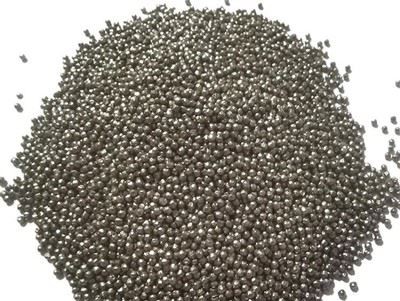
Single Quenched Steel Shot: The Fe3O4 oxide film formed on the surface of single quenched steel shot is relatively thin. This is because it has not been reheated and quenched a second time. As a result, the surface of single quenched steel shot often appears very bright, reflecting light more easily.
Två gånger släckt stålskott: Efter den andra släckningsbehandlingen blir Fe3O4 -filmen på ytan av stålskottet tjockare . Detta tjockare oxidlager återspeglar inte ljus såväl som det tunnare skiktet på enstaka släckt stålskott, vilket ger det två gånger släckta stålskottet ett tråkigt utseende .} Men detta förändras inte bara cosmetic; Det är en indikation på de djupare strukturella förändringarna som har inträffat inom stålskottet .
3.2 Mikrostrukturella förändringar
Single Quenched Steel Shot: The microstructure of single quenched steel shot may have larger prior austenite grains. The martensite laths formed during quenching may also be relatively wider. This coarser microstructure can affect the mechanical properties of the steel shot, as mentioned earlier, making it more prone to breakage under stress.
Twice Quenched Steel Shot: The second quenching process effectively refines the prior austenite grain size and martensite lath width. This refined microstructure is more homogeneous and stable, contributing to the improved hardness, toughness, and wear resistance of the steel shot. The finer grains and laths provide more interfaces to resist crack propagation, enhancing the overall performance of the stålskott .
4. Applikationer och branschpåverkan
4.1 olika applikationsscenarier
Single Quenched Steel Shot: Due to its relatively lower cost (compared to twice quenched steel shot) and sufficient performance for some less - demanding applications, single quenched steel shot is often used in general - purpose surface cleaning in the construction industry, such as removing rust from steel beams in building projects. It is also suitable for applications where the surface treatment requirements are not extremely high, like in some small - scale metalworking shops for basic deburring operationer .
Twice Quenched Steel Shot: The aerospace industry heavily relies on twice quenched steel shot for its high - precision surface treatment needs. For example, in the manufacturing of aircraft engines, where the surfaces of components need to be free from any defects and have excellent fatigue resistance, twice quenched steel shot is used for shot peening to improve the surface integrity. In the automotive industry, it används för att behandla höga stressdelar som vevaxlar för att förbättra deras hållbarhet .
4.2 Bransch - bred betydelse

Cost - effectiveness Considerations: For industries with tight budgets and less - critical surface treatment requirements, single quenched steel shot offers a cost - effective solution. However, for industries where product quality and performance are of utmost importance, the higher initial cost of twice quenched steel shot is offset by its longer service life and better performance, resulting in overall cost savings in the long term.
Körning av tekniska framsteg: Utvecklingen och användningen av två gånger släckt stålskott har stimulerat tekniska framsteg inom metallbearbetnings- och ytbehandlingsindustrin . Tillverkare undersöker och förbättrar ständigt ytbehandlingen för att ytterligare förbättra prestandan för stålskott, vilket leder till utvecklingen av mer effektiva och högkvalitativa ytbehandlingstekniker.}}}}}}}}}}}}}.}}}}}}})
In conclusion, the differences between twice quenched steel shot and single quenched steel shot are significant in terms of performance, appearance, and microstructure. These differences have a profound impact on their applications across various industries, with each type of steel shot finding its niche based on the specific requirements of different surface treatment tasks. As technology continues to evolve, the performance gap between the two may further widen, opening up new Möjligheter för metallbearbetnings- och ytbehandlingssektorerna .